
In brief
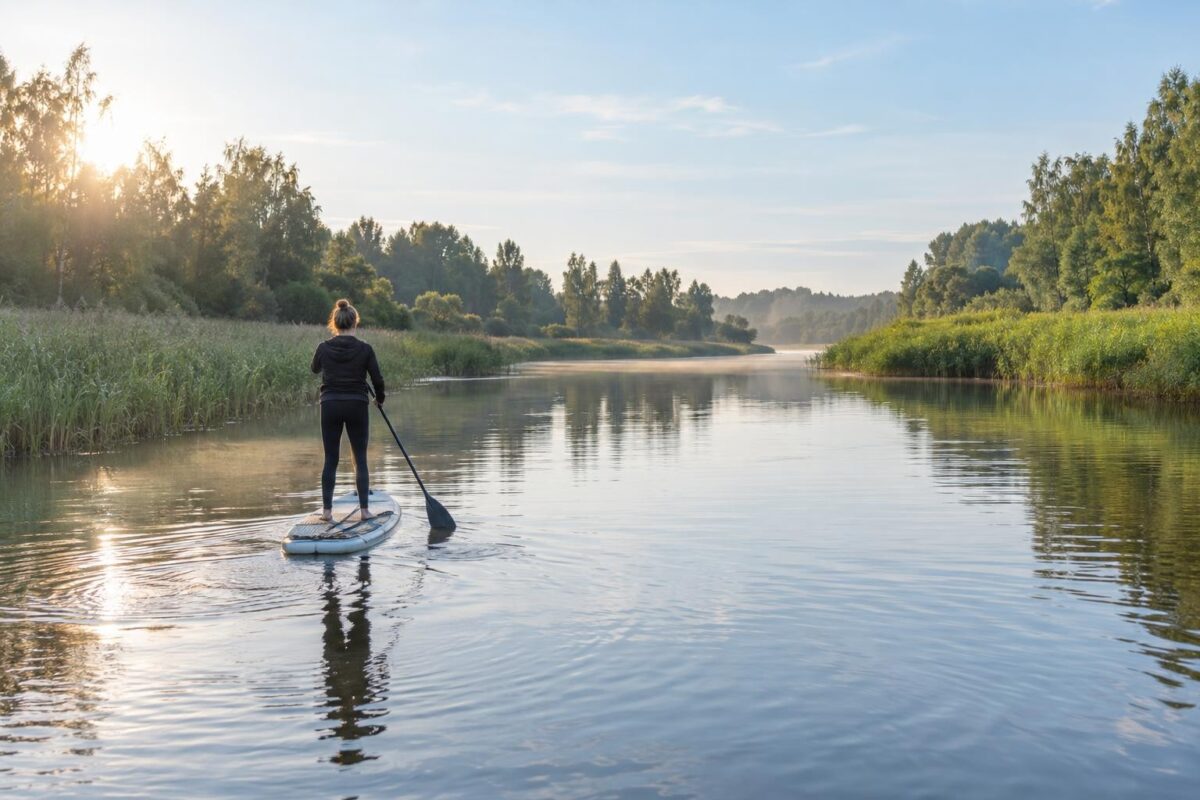
- For a beginner and for trips on Latvian rivers and lakes, an inflatable all-round (all-round) board with a length of about 3–3,4 m and a width of about 80–86 cm is usually the most suitable.
- For longer trips with luggage, a longer and narrower touring board is suitable, as it glides faster and holds its course better.
- Choose a board whose maximum load specified by the manufacturer comfortably exceeds your weight together with your belongings.
- In Latvia, a lifejacket is required on a paddleboard for every person on it. Children under 12 years of age must wear the lifejacket.
Inflatable or solid
Most recreational SUP boards are inflatable. A deflated board can be put in a rucksack and carried in a car boot or on a train. It withstands knocks against stones and the bank and is softer if you fall onto it. Inflating and packing take time, and with a hand pump they also take effort.
A solid board (made of fibreglass, carbon fibre or plastic) is stiffer and faster, and it is more precise in waves. It needs space at home and a roof rack. On a river with stones and shoals, it must be paddled more carefully.
Board types
| Type | Length (approximate) | Width (approximate) | Suitable for |
|---|---|---|---|
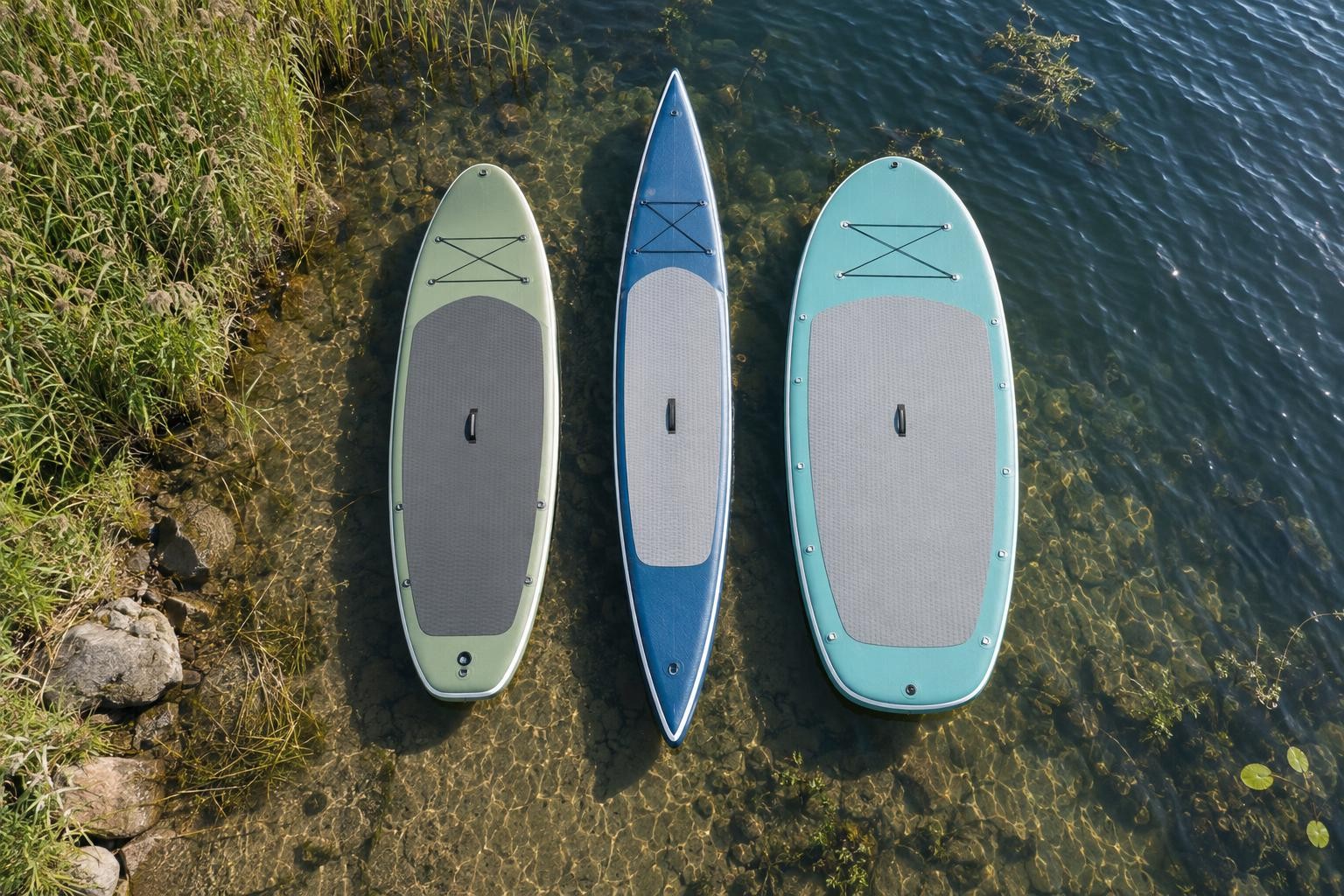
| All-round (all-round) | 3,0–3,4 m (10–11 feet) | 80–86 cm (31–34 inches) | Beginners, lakes, calm rivers, short trips |
| Touring (touring) | 3,5–4,3 m (11,5–14 feet) | 71–81 cm (28–32 inches) | Long trips, trips with luggage, large lakes |
| Short (children’s, wave) | up to 3 m | varies | Children, lighter paddlers, manoeuvres in waves |
| Wide (yoga, family) | about 3–3,4 m | 86 cm or more | Stability, yoga, paddling with a child or dog |
An all-round board usually has a wide, rounded nose and glides over the water surface. It is stable when you are standing still and easy to turn. A touring board often has a pointed nose that cuts through the water. It is faster and holds its course better, but may seem less stable at first.

Size by weight
The board carries not only the paddler but also everything they take with them. The greater the board’s volume and width, the more stable it is. The formulas that different manufacturers use to calculate volume by weight differ, so it is more practical to use the recommended paddler weight or maximum load specified by the manufacturer.
- Add up your own weight and what you will carry: a bag, water, perhaps also a child or dog.
- Choose a board whose maximum load comfortably exceeds this total. If you are close to the limit, the board sits deeper in the water, is slower and less stable.
- A beginner or a heavier paddler is better suited to a wider and thicker board. The standard thickness of inflatable boards is about 15 cm (6 inches). Thinner boards are suitable for lighter paddlers and children.
- If the board will have to be carried or portaged around obstacles, also consider its weight and packed size.
Paddle, fins and safety leash
Paddle
A paddle that is approximately 15–25 cm longer than the paddler is usually recommended. An adjustable paddle is convenient if several people use the board. A carbon fibre or fibreglass paddle is lighter than an aluminium one, and this is noticeable on a long trip.
Fins
A large central fin helps the board hold its course. On a shallow river with stones and submerged trees, a smaller or flexible fin is useful, and it is worth removing it before a shoal.
Safety leash (leash)
On a lake, the leash prevents the wind from blowing the board away if you fall into the water. On a river with a current, an ankle leash can be dangerous: if it catches on a tree or another obstacle, the current can hold a person under the water. On a river, use a leash that is attached to a belt with a quick-release buckle, so that it can be unfastened with a single movement.
How to choose: step by step
-
Decide where you will paddle
Lakes, calm rivers, sea bays? A shorter, easily turned board is suitable for winding small rivers. A longer board is suitable for large lakes and long stretches.
-
Add up the load
Your own weight, belongings and passengers. Compare the total with the maximum load specified by the manufacturer.
-
Try it out
Before buying, hire a board or several boards and paddle them for at least an hour. This is the best way to feel the difference in stability and speed.
-
Check the set
A pump with a pressure gauge, paddle, fin, leash, carry bag and repair kit. In the cheapest sets, the paddle and the pump are often the weakest part.
What to take with you
- Lifejacket
- Phone in a waterproof pouch
- Water and snacks in a waterproof bag secured with the board’s bungee cords
- Clothing that withstands getting wet, and dry clothes on the bank
- Headwear and sun cream
- On a river: a plan for getting back to the starting point
You will find the routes in the section SUP routes. If you will be travelling by boat or canoe, see the boat routes.
Sources
- Regulations on the movement of vessels in inland waters (Cabinet Regulations No. 92 of 09.02.2016), clause 18 and Annex 1
- Paddle UK (British Canoeing): SUP safety — choosing the right leash
- Alpkit: What size SUP do I need?
- REI: Paddle board (SUP) buying guide
- Surf Magazin: SUP paddle — three steps to the right length